Towards Co-AM
Introduction
- Transition from asset owner-centric AM to ecosystem-level collaboration (Co-AM)
- Co‑AM stakeholders, roles and relationships across the lifecycle
- Principal elements of Co-AM
Collaborative asset management (Co-AM): how does it change operations?
While traditional asset management focuses on optimizing assets within a single organization, Co-AM enables ecosystem-level coordination, shared use of asset lifecycle data, and collective value creation across organizational boundaries.
What is changing?
- Shift asset management from an asset-owner perspective toward an ecosystem-based model.
- Value is created collectively.
- Organizations in the ecosystem may operate their own asset management systems; however, collaborative asset management requires these systems to be aligned with the asset owner’s asset management objectives to ensure coherence in planning, execution, and performance evaluation.
Characteristics of Co-AM
- Multiple organizations and stakeholders.
- Collaborative operation, maintaining and improving assets throughout the lifecycle.
- Enabled by shared data, aligned asset management systems, and coordinated responsibilities.
Traditional owner-centric AM vs. Co-AM
While traditional AM focuses on optimizing assets within a single organization, Co-AM emphasizes ecosystem‑level coordination (trust, rules), shared data, and joint value creation throughout the asset lifecycle.
| Aspect | Traditional AM | Collaborative AM (Co-AM) |
|---|---|---|
| Governance | Owner-centric governance | Ecosystem-centric, shared governance |
| Stakeholders | Single dominant owner | Multi-stakeholder cooperation |
| Data | Siloed data, proprietary | Shared data, interoperability |
| AMS | One AMS per owner | Multiple aligned AMS across organizations |
| Lifecycle | Owner responsible for lifecycle management | Joint lifecycle management with shared responsibilities |
| Business models | Transactional, cost-driven | Value-sharing, new service models |
| Culture | Low transparency | Trust, collaboration, shared rules, transparent |
Asset management in the ISO 55000 context: traditional asset management
Traditional asset management under ISO 55000 is internally focused and owner-centric. Governance is centralized, with planning guided by asset owner-led Strategic Asset Management Plan (SAMP). Data, competencies, and lifecycle operations typically remain within organizational silos. Performance is assessed using internal KPIs. Improvement occurs through internally managed continuous-improvement processes.
| ISO 55000 | Traditional AM |
|---|---|
| Context | Internal, owner-centric |
| Leadership | Centralized governance |
| Planning | One SAMP, owner-led |
| Support | Siloed data, internal competencies |
| Operation | Owner-run lifecycle processes |
| Evaluation | Internal KPIs |
| Improvement | Internal continuous improvement |
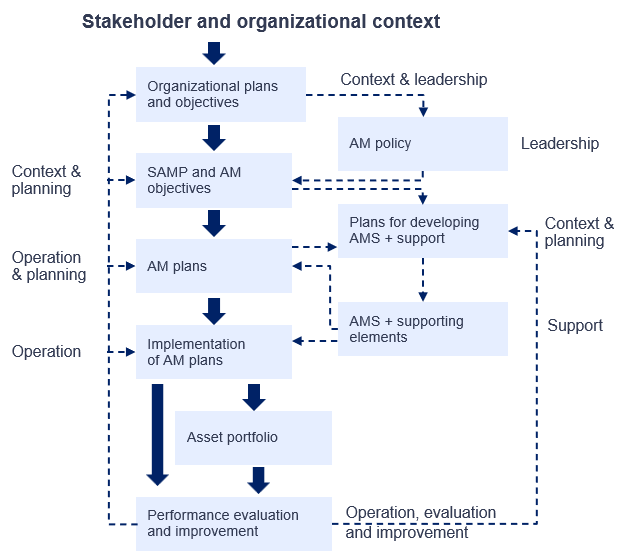
Collaborative asset management
In contrast to the traditional asset management, the Figure 2 and Table 3 below present a collaborative, ecosystem-wide approach to asset management. It aligns shared plans, objectives, policies, risks, values, and KPIs across organizations. Partners jointly implement asset-management plans through common processes and shared maintenance and analytics capabilities. Supporting elements include interoperable asset-management systems, shared data spaces, and cross-organizational competencies. Performance is evaluated through ecosystem KPIs, collaborative value creation, and shared learning.
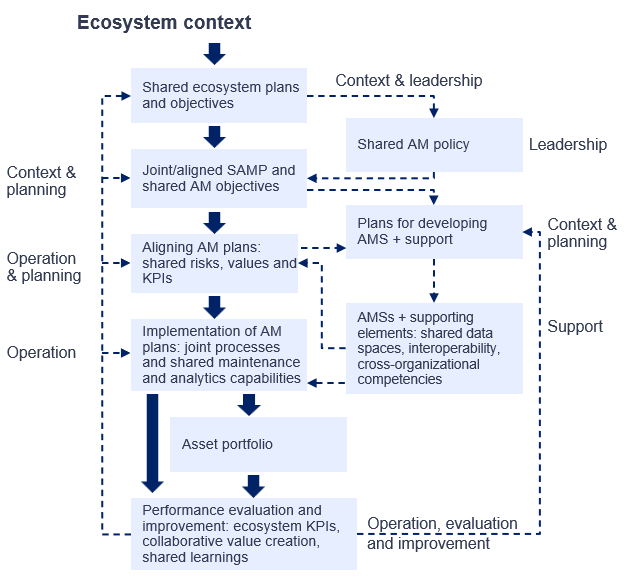
| ISO 55000 | Co-AM |
|---|---|
| Context | Network/ecosystem context with multi-party dependencies |
| Leadership | Shared governance, trust frameworks |
| Planning | Multi-AMS alignment; shared risks, values, KPIs |
| Support | Shared data spaces, interoperability, cross-organizational competences |
| Operation | Joint lifecycle processes, shared maintenance and predictive capabilities |
| Evaluation | Ecosystem KPIs, collaborative value realization |
| Improvement | Multi-party improvement cycles, shared learning |
Stakeholders description: multi-stakeholder ecosystem
A brief overview of the various actors typically involved in a networked production-asset lifecycle-management environment.
| Role type | Role | Description (role in ecosystem) |
|---|---|---|
| Industrial customer | Capital intensive industrial company | Uses and manages production assets in their production sites. |
| Production asset manufacturer | Production asset manufacturer | Produces (and usually also maintains, remanufactures, refurbishes) production assets for industrial customer. |
| Production asset component provider | Produces (and usually also maintains, remanufactures, refurbishes) production asset components for industrial customer. | |
| Lifecycle (maintenance) service provider | Maintenance service provider | Provides different types of maintenance services for industrial customer. |
| Supportive service provider | Asset management solution provider | Provides solutions for ecosystem’s asset management. |
| Inspection services | Provides inspection services for production mills. | |
| Logistics provider | Provides delivery (or reverse) logistics for assets / spare parts etc. | |
| Engineering & consulting | Provides engineering services. | |
| ERP/MES solution provider | Provides ERP/MES solutions for industrial customer. | |
| Data management & analytics | Provides data related services. | |
| EOL & recycling partner | Materials recycling, component / spare part recycling. | |
| System integration service provider | Company providing integration services for IT and industrial systems. | |
| Ecosystem and infrastructure provider | Ecosystem coordinator | Daily ecosystem activities. Communicates ecosystem and engages new partners. |
| Infrastructure service providers | Provides tools, cloud services and interfaces for ecosystem operation and management. |
Colife ecosystem stakeholders
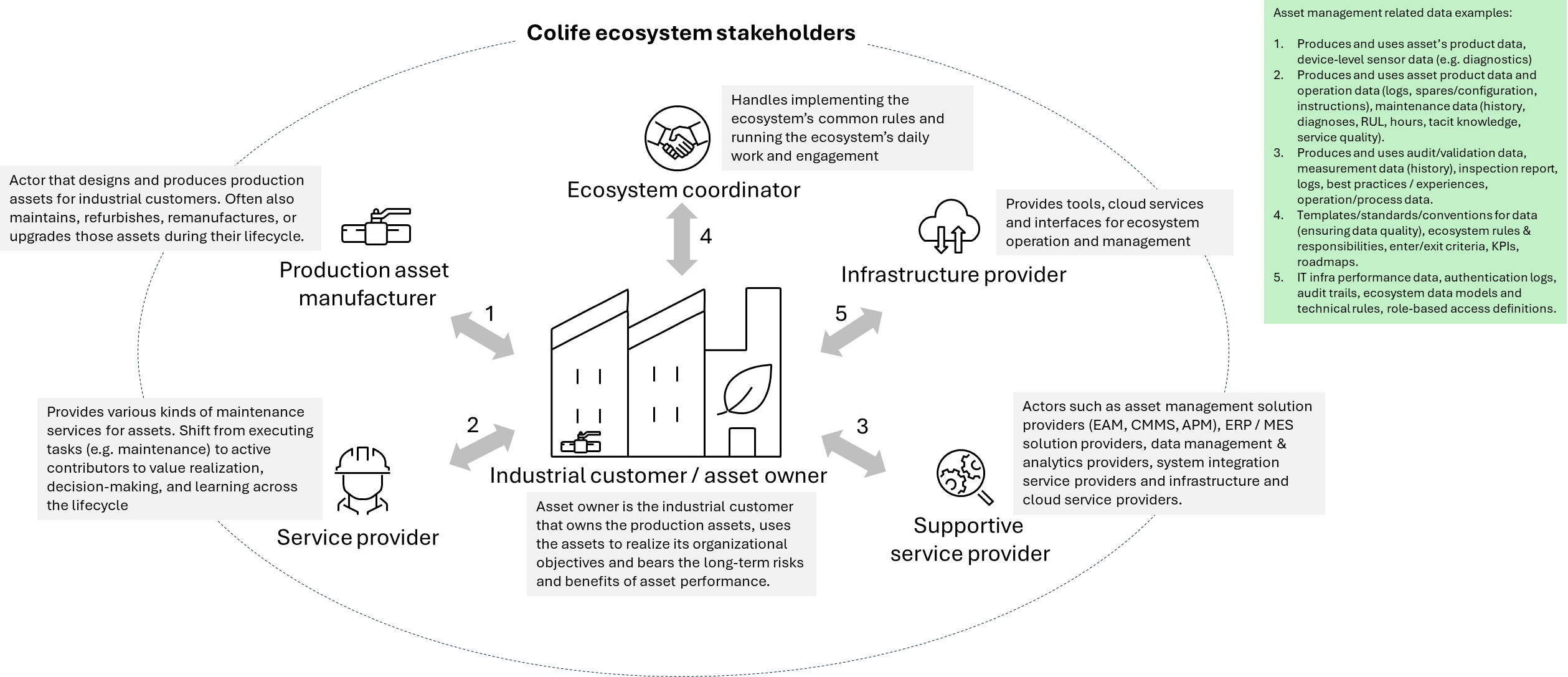
The Colife ecosystem brings together multiple stakeholders that collaborate around asset lifecycle data to improve asset management practices and create value from shared information. At the center of the ecosystem is the industrial customer or asset owner, which owns and operates production assets and is ultimately responsible for their performance, risks, and lifecycle outcomes.
Click the image to open a full-screen preview.
The asset owner collaborates with several stakeholder groups:
- Production asset manufacturers
- Production asset manufacturers design and deliver industrial equipment and production assets. In many cases, they also support the asset throughout its lifecycle through maintenance, upgrades, refurbishment, or remanufacturing activities. Manufacturers contribute valuable product knowledge, design information, and device-level data that can support improved asset management and decision-making.
- Service providers
- Service providers deliver maintenance and other lifecycle services for production assets. Their role is evolving from executing individual maintenance tasks toward actively supporting value creation, data-driven decision-making, and organizational learning across the asset lifecycle. Service providers contribute operational experience, maintenance records, and practical knowledge about asset condition and performance.
- Supportive service providers
- Supportive service providers supply specialized solutions and expertise that enable effective asset management. These may include asset management software providers, data analytics companies, system integration partners, ERP and MES solution providers, and other organizations that help collect, process, analyse, and utilize asset-related data.
- Infrastructure providers
- Infrastructure providers offer the technical foundation that enables ecosystem collaboration. Their services can include cloud platforms, data-sharing environments, communication interfaces, and other digital infrastructure required for managing data and supporting ecosystem operations.
- Ecosystem coordinator
- The ecosystem coordinator is responsible for establishing common operating principles and facilitating collaboration between ecosystem participants. The coordinator manages governance processes, stakeholder engagement, ecosystem rules, and day-to-day coordination activities that ensure the ecosystem functions effectively.
Continue exploring
- Previous: Playbook overview
- Next: Examine Co-AM in your context