Governance, interoperability, quality, and technologies
Introduction
- This part of the Colife playbook enables you to identify the key issues related to data sharing from the viewpoint of your own company, and to select the best suitable ecosystem model that implements those issues.
- In this part, the key questions related to data governance, quality, interoperability, and technology should be thought through and used to identify how those should be solved.
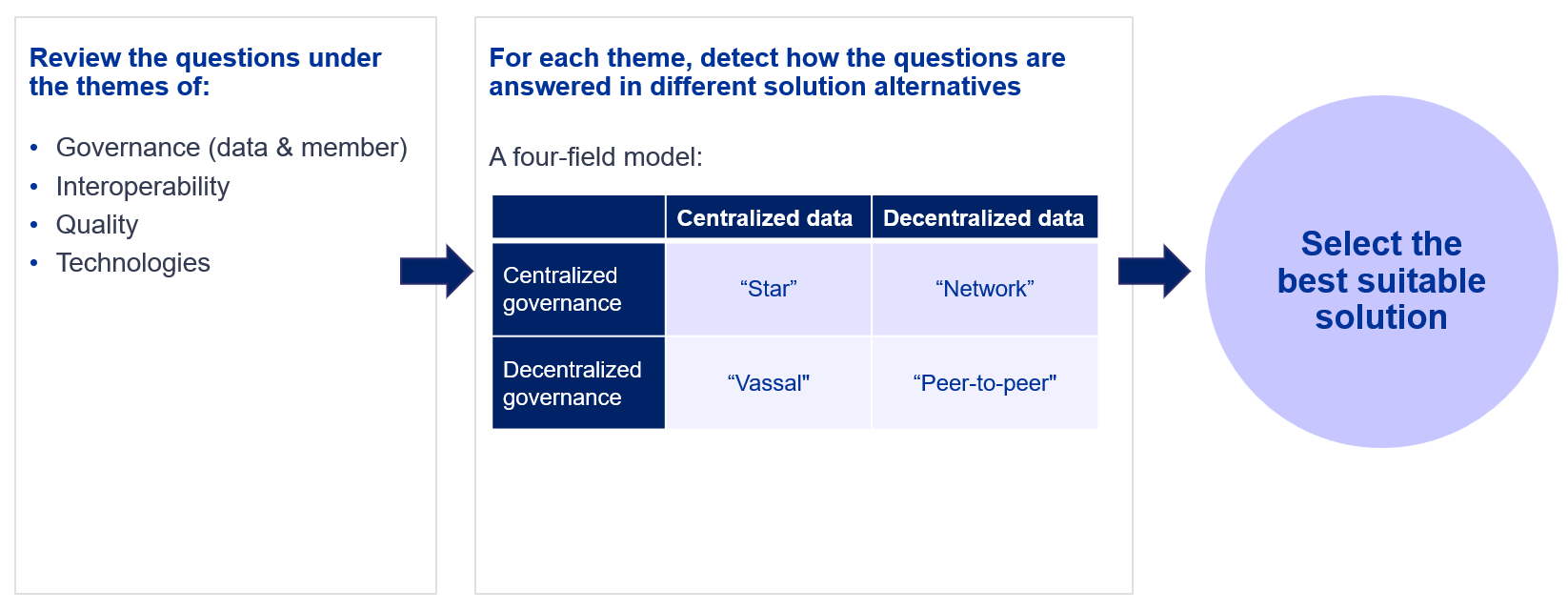
- Four different solution alternatives for data sharing are presented, with the dimensions of centralization and decentralization of both governance and data, describing the power dynamics of data sharing.
How to select the most suitable ecosystem model
Introduction of the four-field model
- The four-field model describes four different solution alternatives for ecosystem data and governance.
- Centralization/decentralization of data and governance affects:
- The control of the ecosystem members and data.
- Members’ trustworthiness and data quality verification.
- Rules, roles, and responsibilities.
- The location of data.
- Data access and interoperability.
- Ecosystem maintenance and joining effort.
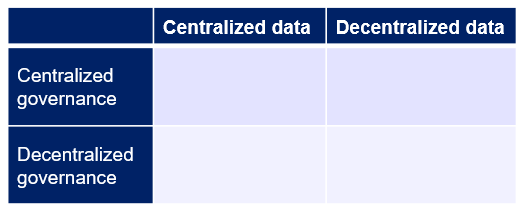
Introduction of the four-field model: governance
| Centralized data | Decentralized data | |
|---|---|---|
| Centralized governance | Central entity is the owner of the use case and decides also who are participating into the data sharing. Central entity decides rules, interfaces, and responsibilities. |
Governance is centralized and common rules of data sharing are decided among the participants, keeping the field more equal and fairer. Governance processes are important to be transparent and predictable. |
| Decentralized governance | For example, there could be a joint entity that handles the data on behalf of the participants. Shared responsibility, but for the customer it might appear unitary. |
Approach is lightweight as it does not have oversight or rules, but it may be chaotic and unable to scale. Governance is done case by case and different connections are maybe governed differently. |
Introduction of the four-field model: data
| Centralized data | Decentralized data | |
|---|---|---|
| Centralized governance | Data is transferred to a central entity which decides the use of the data. Use case example: Electronic Health Records. |
The data is kept within the hands of the owner, ensuring data ownership and control. Data sovereignty. Use case example: City data ecosystem. |
| Decentralized governance | Centralizes the data but decentralizes the governance. Use case example: Co-operative electric car charger network. |
Approach is lightweight as it does not have oversight or rules, but it may be chaotic and unable to scale. The approach lets the participants create and tailor their own connections between the participants. Use case example: Sustainability data ecosystem. |
Governance – checklist questions
- Who owns the data?
- Are the member rights and responsibilities defined in the ecosystem?
- Are the stakeholders contractually related to each other or through a single main actor?
- Who gets to decide whether new parties can join or leave the ecosystem?
- Are there any criteria for joining the ecosystem and who decides on these criteria?
- How to ensure the trustworthiness of the ecosystem members?
- Who decides on the rules related to the operation and data processing of the ecosystem?
- What support/how much support does the ecosystem offer to its members (e.g. quality assurance services, data analysis services, ready-made contract templates, etc.)?
- How are the conflicts between ecosystem members solved?
Governance – the four-field model
| Centralized data | Decentralized data | |
|---|---|---|
| Centralized governance | The main actor controls the ecosystem and decides the members. There may be strict rules or only recommendations for data management. Contracts between data providers and users describe users’ rights and responsibilities with the data. |
Roles and responsibilities in the ecosystem and with the data are strictly defined. Strict criteria for member acceptance and trustworthiness evaluation. Strict contracts between data providers and users. Support services may be provided for data management. |
| Decentralized governance | Key actors form the core of the ecosystem together and agree jointly the (loose) rules, practices, and new members. | Close to common business-to-business data transfer. Terms and rules are agreed in the contract. Trust is often evaluated informally. |
Interoperability – checklist questions
- Is there a specific format in which the data should be?
- Are there specific standards or rules to be followed?
- Is the metadata defined?
Interoperability – the four-field model
| Centralized data | Decentralized data | |
|---|---|---|
| Centralized governance | Data controller decides the data formats, standards, metadata, and practices, and the level of those. Others must follow these. | Jointly agreed, common data models, standards, etc. that all members are obligated to follow. Strict metadata procedures for the data. |
| Decentralized governance | Usually, the main organizations decide the data formats, standards, metadata, etc., but the practices may be flexible. The interoperability rules may be more informal. | Data provider and data user agree bilaterally about the data formats and standards. These are defined in the contract. Metadata may be considered unnecessary. |
Quality – checklist questions
- Who is responsible for the data quality?
- Are there common policies for data quality description and evaluation?
- How to validate the quality of the content (data, metadata, and measuring equipment)? Is the data transparent?
Quality – the four-field model
| Centralized data | Decentralized data | |
|---|---|---|
| Centralized governance | The data quality is verified according to the defined practices of the main actor. It depends on the main actor at what level these are defined and implemented. Quality validation is the responsibility of the data providers. | There are common ecosystem policies for data quality description and validation. The data must be validated before it is brought to the ecosystem. There might be tools available for the validation. Metadata includes quality metadata. |
| Decentralized governance | The main organizations decide how to ensure the data quality. These may be more informal and more trust-based. | Data quality is defined in the contract between the data provider and user, and both parties verify it on their own behalf according to their own practices. |
Technologies – checklist questions
- Where is the data stored?
- Who is responsible for maintaining the master data?
- How is the data accessed (interfaces and protocols for data exchange)?
- Is the same data available to every member equally?
- Is there a need to limit data visibility in the data ecosystem?
- Who acts as the coordinator of the ecosystem?
- Who is responsible for choosing the standards to be used for data transfer?
- How are the security issues solved in data transfer?
- How and by whom is the data privacy taken care of?
- What is the role of data infrastructure maintainer?
Technologies – the four-field model
| Centralized data | Decentralized data | |
|---|---|---|
| Centralized governance | Central actor maintains the data storage, implements the interfaces and protocols for data exchange, and takes care of security processes. Other actors must conform to these. | Each actor has its own infrastructure and data storage and is responsible for maintaining it. Data transfer protocol is decided by the centralized governance body and actors are conforming to it, being responsible on their own behalf. |
| Decentralized governance | Actors maintain their own data but allow it to be aggregated at the central point, which is, for example, a customer interface to make it show as a unitary service. Virtualization and APIs may be used. | Security issues are solved and protocols are agreed case-by-case. Interfaces between actors may be all different and data modelling is not dictated. |
Applicable technologies for the solutions of the four-field model
| Centralized data | Decentralized data | |
|---|---|---|
| Centralized governance | Databases Data lakes Platforms Common data repositories |
Data spaces Data mesh |
| Decentralized governance | Virtualization | Blockchains E-mails Portals Tailored APIs |
Positioning yourself according to results
- Building a multi-stakeholder data sharing ecosystem can be done with different amount of centralisation
- The main goal for the questions is guiding the user through right mindset by using the questionnaire and reveal details in data sharing.
- What kind of characteristics, limits and environment exist and need to be taken into account?
- The centrality of data storage and governance is determined through results and positioning of current/possible approach to data sharing can be done
- Delving more into technologies that are described at identified approach is recommended
Summary
The division between centralization and decentralization has become apparent in both member and data governance in ecosystems.
The four-field model provides four different approaches to implement data and governance in ecosystems using the axes of centralization, consisting of a data and governance matrix.
The model
- enables companies to detect differences between the data-sharing approaches,
- provides guidance on selecting an appropriate model,
- manages the required properties related to governance, interoperability, and quality for data sharing, and
- introduces technical data sharing implementations.
Continue exploring
- Previous: Identify your business opportunities
- Next: Examine examples