Review the basics
This section establishes the terminology, logic, and fundamentals that frame collaborative asset management and its relationship to asset data.
What you’ll find here
- Builds a shared vocabulary for asset management and Co-AM.
- Connects terminology, lifecycle thinking, and ecosystem collaboration.
Asset management terminology
- Asset
- Item, thing, or entity that has potential or actual value to an organization. Assets can be physical or non-physical. A grouping of assets, referred to as an asset system, can also be considered an asset. E.g. a pump, a valve, control software, a router, a production line, a wrapping system, or an automation system. (ISO, 2024a)
- Asset management (AM)
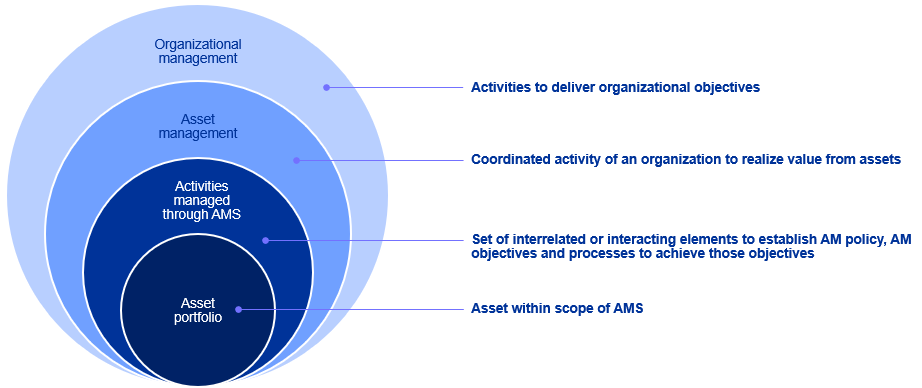
- “Coordinated activity of an organization to realize value from assets.” Realization of value normally involves a balancing of costs, risks, opportunities and performance benefits. The term “activity” has a broad meaning and can include, for example, the approach, planning and plans, and their implementation. (ISO, 2024a)
- Collaborative asset management (Co-AM)
- The coordinated activities of an ecosystem to realize value from its assets. Co‑AM enables ecosystem‑level coordination, shared use of asset lifecycle data, and collective value creation across organizational boundaries.
- Strategic asset management plan (SAMP)
- Documented information that contains and aligns asset management policy, objectives, strategies, and approaches for developing and managing the asset portfolio and asset management system. (ISO, 2024a)
- Asset management system (AMS)
- Set of interrelated or interacting elements to establishes AM policy, AM objectives, and processes to achieve those objectives. AMS can be organized in different ways, either informally or with a more formal structure, depending on the organization’s specific needs and operational complexity. Many organizations incorporate AMS requirements into their overall management system. (ISO, 2024a)
- Asset management plan (AMP)
- Documented information that specifies the activities, resources, costs and timescales required for an individual asset, or a grouping of assets, to achieve an organization’s asset management objectives.
- Governance
- Governance involves all the strategies, policies, procedures, roles, responsibilities and control over the management of the data and members in an ecosystem context.
- AM ecosystem
- A collaborative organization where stakeholders cooperate and coordinate their activities to co-create value for the industrial customer and all members of the ecosystem in the context production assets.
- Business model
- Describes how an organization creates, delivers, and captures value for customers while generating profit. It typically identifies a company’s products or services, target customers, revenue sources, and cost structure.
- Federated learning
- A collaborative machine learning approach that enables multiple stakeholders to learn from distributed asset lifecycle data without sharing raw data, supporting ecosystem-level collaboration and value creation while maintaining local data control.
- Data economy
- An area of the economy where ecosystem partners and actors share data and make it accessible and usable for others in order to create new business opportunities in data economy ecosystems. (Korolainen and Ojanen, 2026)
- Asset data
- “Data that lists and describes an asset”. Asset data can exist in different formats. Asset data can support AM decision-making.(ISO, 2024b)
- Data asset
- Data that has the properties of an asset and can be managed as an asset.
- Asset data management
- AM relies on effective decision-making which relies on data and information. Asset data used to inform decision-making requires effective management. Asset data management can be defined as coordinated management of asset-related data and information across the asset lifecycle to ensure data quality, accessibility, interoperability, and effective use in AM activities, enabling realization of value from assets. [(ISO, 2024b)]
Asset management fundamentals: linking assets to organizational objectives
In organizational contexts, assets, asset management activities, and the asset management system are structured in a nested manner, linking assets to organizational objectives.
Asset management fundamentals: structured lifecycle of asset data
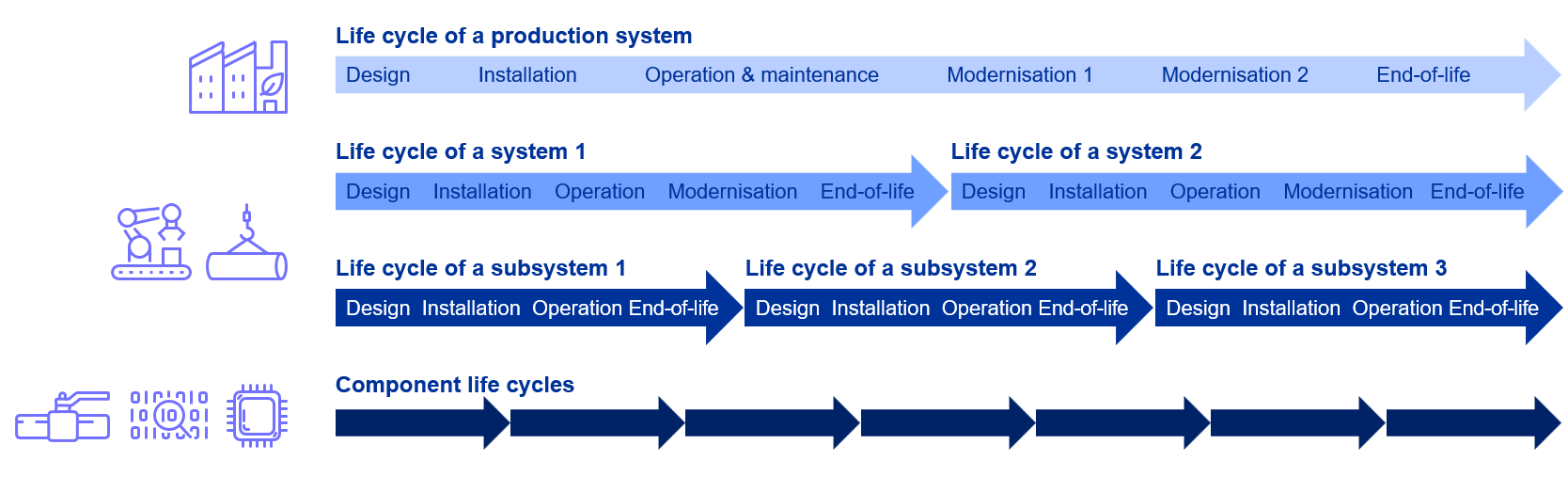
Lifecycle complexity emerges from system hierarchy. Multiple lifecycles exist at different system levels (see Figure 2). Complexity arises from keeping lifecycle information consistent across levels.
Asset data evolves throughout the lifecycle
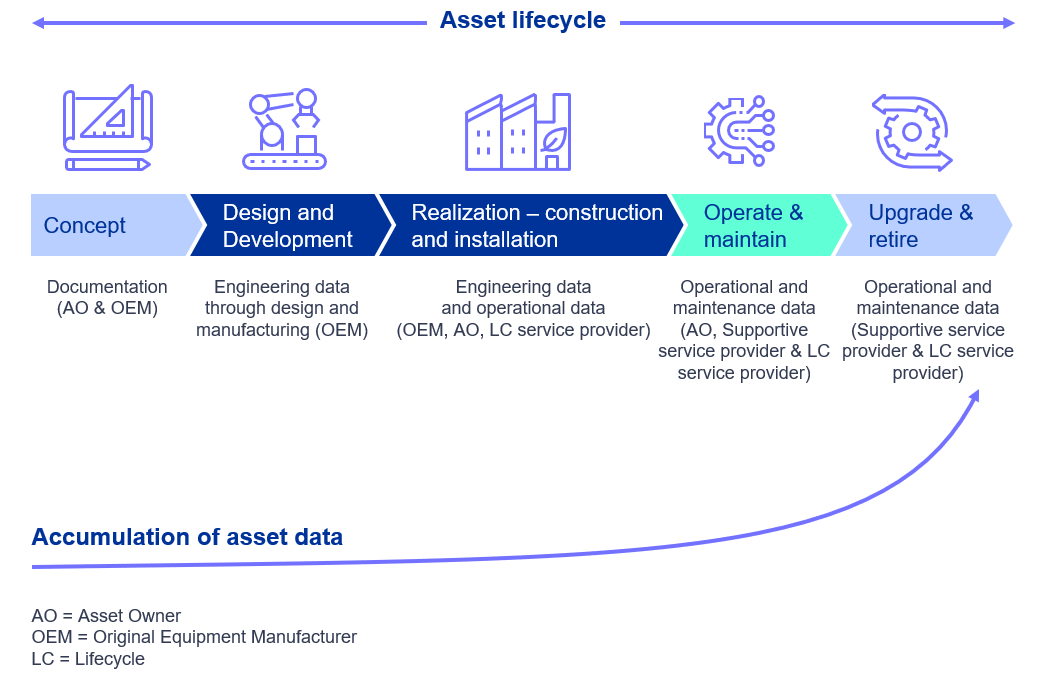
- Asset data is created, accumulated, and refined throughout the lifecycle of a production asset (Figure 3).
- During concept and design stages, the available information mainly describes requirements, assumptions, intended functions, and planned solutions.
- Construction and installation add detailed information about the asset as realized, while operation and maintenance generate data on actual performance, condition, interventions, and changes.
- Upgrades and retirement further modify and complement the asset record.
- As a result, asset data develops from an initially abstract description into an increasingly detailed representation of the physical asset and its lifecycle history.
Data as a strategic asset
Data asset = data that has the properties of an asset
- Data is a key enabler of collaborative asset management ecosystems
- However, it is often scattered in several information systems. This fragmentation often makes it difficult to utilize the information
Managing the lifecycle of production assets requires:
- Access to a wide range of information types and systematic data management practices.
- Reliable and high-quality data is needed to support design, installation, use, and end-of-life phases.
Based on (Kortelainen et al., 2023; ISO, 2024b)
Asset data types
| Category | Examples |
|---|---|
| Asset creation | Asset history information |
| Service strategy | Design information |
| Asset strategy | Operating manuals |
| Maintenance history | Metadata |
| Maintenance planning | Documented information, reports |
| Operations | Images and multimedia |
| Reporting | Work orders |
| Capital works | Market data |
| Asset disposal | Customer data |
| Condition assessment | Other data such as weather data |
Continue exploring
- Previous: Playbook overview
- Next: Examine Co-AM in your context
References
Hanski, J. et al. (2012) Development of knowledge-intensive product-service systems. Outcomes from the MaintenanceKIBS project. VTT. Available at: https://publications.vtt.fi/pdf/technology/2012/T21.pdf.
ISO (2024a) “ISO 55000:2024 Asset management — Vocabulary, overview and principles.”
ISO (2024b) “ISO 55013:2024 Asset management — Guidance on the management of data assets.”
Korolainen, R. and Ojanen, V. (2026) “Unpacking the Concept of Data Economy,” in Proceedings of the XXXVII ISPIM Innovation Conference. Granada, Spain. Available at: https://conferencesubmissions.com/ispim/granada26/documents/1534761140_Paper.pdf.
Kortelainen, H. et al. (2023) Knowledge-Based Life Cycle Management. Kunnossapitoyhdistys Promaint ry. Available at: https://cris.vtt.fi/en/publications/knowledge-based-life-cycle-management-2/.