graph TD
    %% Define clean, high-contrast node classes
    classDef globalModel fill:#e6f3ff,stroke:#5b9bd5,stroke-width:2px,color:#000000;
    classDef localNode fill:#fff2cc,stroke:#d6b656,stroke-width:2px,color:#000000;
    classDef data fill:#e2efda,stroke:#70ad47,stroke-width:2px,color:#000000;

    %% Top Organization (Removed parentheses and commas)
    subgraph OrgC ["Organization C"]
        DataC[("Local asset data")]:::data
        TrainC["Local Training"]:::localNode

        %% Dotted line shows local relationship
        DataC -.-> TrainC
    end

    %% Central Hub (Moved iteration text inside the node)
    Global["Shared Global Model<br/>(Central Aggregator)"]:::globalModel

    %% Bottom Left Organization
    subgraph OrgA ["Organization A"]
        TrainA["Local Training"]:::localNode
        DataA[("Local asset data")]:::data

        TrainA <-.- DataA
    end

    %% Bottom Right Organization
    subgraph OrgB ["Organisation B"]
        TrainB["Local Training"]:::localNode
        DataB[("Local asset data")]:::data

        TrainB <-.- DataB
    end

    %% Connections
    TrainC <-->|"Encrypted updates"| Global
    Global <-->|"Encrypted updates"| TrainA
    Global <-->|"Encrypted updates"| TrainB

    %% Force subgraph styling
    style OrgC fill:#f9f9f9,stroke:#b2b2b2,stroke-width:1px,color:#000000
    style OrgA fill:#f9f9f9,stroke:#b2b2b2,stroke-width:1px,color:#000000
    style OrgB fill:#f9f9f9,stroke:#b2b2b2,stroke-width:1px,color:#000000
Examine examples
Upgrade project
Motivation: This example illustrates how collaborative asset management (Co-AM) can be realised in a large-scale brownfield modernization project. It highlights both successful practices and persistent challenges related to lifecycle data management across multiple stakeholders.
The case example analyses:
- realization of lifecycle data management in the upgrade project,
- enabling and hindering factors for Co-AM,
- business, governance, interoperability, quality, and technology aspects related to the case.
Realization of lifecycle data management in the upgrade project
- A shared project data environment (Project DB) served as the primary collaboration platform, enabling document management, information sharing, and traceability.
- Multiple digital representations of assets, including 3D models, point clouds, and photoscans, supported engineering activities and remote collaboration.
- Standardized templates and asset identification practices (position numbering) improved consistency of information across participating organizations.
- Upon project completion, lifecycle information was distributed across several operational systems (asset database, ERP, 3D model repositories, etc.), resulting in varying levels of interoperability and integration.
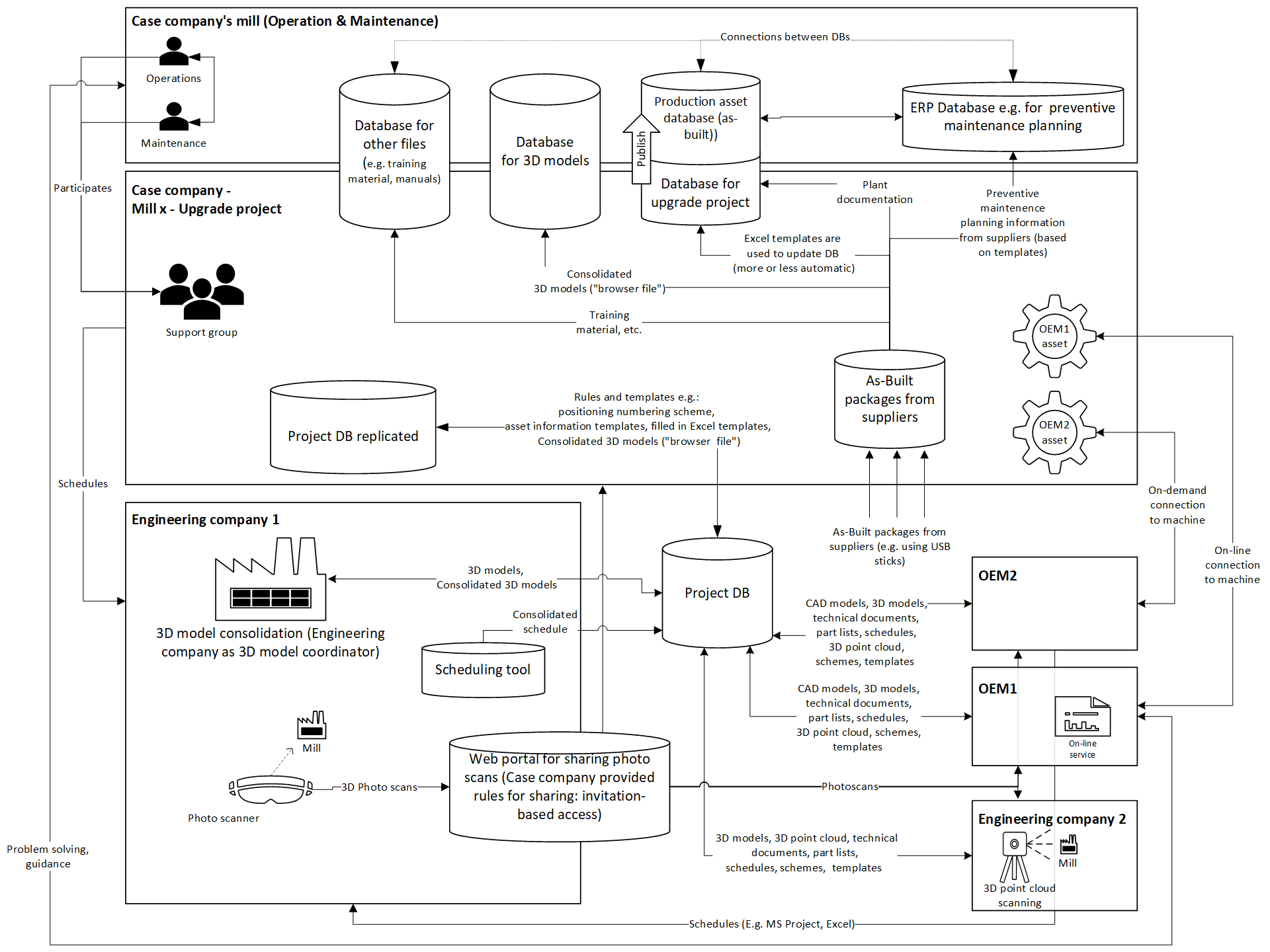
Source: Kääriäinen et al. (2026)
Tip
Click the image to open a full-screen version and inspect the detailed data flows.
Enabling and hindering factors for Co-AM in the upgrade project
- Enabling practices:
- Strong stakeholder involvement (including maintenance and operations early) and “mirrored organizations”.
- Shared platform and transparency → “one source of truth”.
- Standardized asset identification and templates (position numbering).
- Trust, collaboration, and prior relationships.
- Digital tools (e.g. photoscanning) improving collaboration and shared view.
- Structural challenges:
- Lack of up-to-date baseline data (e.g. outdated 3D models).
- System integration gaps → data silos (especially 3D data).
- Late and incomplete data delivery → high workload peaks.
- Inconsistent use of identifiers (position numbers).
- Data quality and metadata issues → difficult to find and use data.
Lessons learned
TipA successful Co-AM implementation in a brownfield upgrade project requires:
- Early involvement of all lifecycle stakeholders.
- Shared data management practices and clear ownership responsibilities.
- Consistent asset identification across organizations and systems.
- Timely and complete information delivery throughout the project.
- Integration of project information into operational asset management systems.
Relevance for collaborative asset lifecycle management
The case demonstrates that effective lifecycle data management in complex brownfield projects depends as much on organizational practices and stakeholder collaboration as on digital technologies. Shared data environments, agreed information models, and trusted collaboration structures are critical enablers for Co-AM, while fragmented systems, inconsistent identifiers, and data quality issues remain significant barriers.
Federated learning in collaborative asset lifecycle management
What is federated learning
Federated learning is a way for several organizations to train a shared machine-learning model without sending their raw data to a central location. Instead, each participant keeps its own data locally and shares only model updates, such as learned patterns or parameter changes.
In practice, this means:
- each organization trains the model on its own local data;
- only the model updates are exchanged;
- a coordinator combines those updates into a better shared model;
- the organizations can collaborate while keeping sensitive or proprietary data under their own control.
This approach is especially useful when data is distributed across multiple sites, systems, or companies and cannot easily be pooled.
How federated learning works
A simple way to describe the process is as a repeated cycle of local learning and shared improvement:
- A shared model is distributed to each participating organization.
- Each organization trains locally on its own data and keeps that data private.
- Only model updates are shared with a coordinator, not the raw data.
- The coordinator aggregates the updates into a better global model.
- The updated model is sent back so the process can continue.
This creates a collaborative learning loop (Figure 2) in which the model improves over time without requiring central pooling of sensitive data.
Key principle: collaboration happens through model training, not through raw-data pooling.
Relevance for collaborative asset lifecycle solutions
TipFederated learning is particularly relevant when
- Data is distributed across multiple actors’ sites or systems,
- No single party has the full picture,
- Joint learning could create more value than isolated local models,
- Raw-data sharing may be difficult or undesirable.
Federated learning enables organisations to generate insights from distributed data while keeping datasets under local control. This makes it a promising approach for collaborative asset lifecycle solutions involving multiple stakeholders across the value network (Table 2).
| Lifecycle stage | Example application area |
|---|---|
| Design and development | Product lifecycle management |
| Manufacturing | Smart manufacturing |
| Operation and performance | Asset performance management |
| Service and maintenance | Predictive maintenance |
| Ecosystem coordination | Manufacturing supply chains |
These application areas share a common challenge: valuable data and expertise are distributed across organizational boundaries. Federated learning provides a mechanism for collaborative model development without requiring centralised sharing of sensitive operational data.
Where federated learning can create value
Industrial studies have demonstrated the potential of federated learning across a wide range of asset lifecycle activities. The strongest evidence currently comes from quality management, manufacturing operations, maintenance, and product lifecycle applications ((Leng et al., 2025), (Zhang et al., 2021), (Geng et al., 2022), (Jiang et al., 2024), (Landau et al., 2026), (Ge et al., 2022), (Siemens and Katulu, 2023)).
Quality management
- Defect prediction and detection
- Process quality modelling
- Learming from production data distributed across multiple sites
Operation and maintenance
- Machinery fault diagnostics
- Anomaly detection
- Predictive maintenance using distributed rare failure data
Product lifecycle management
- Demand forecasting
- Logistics optimization
- Product traceability
- Recycling, and remanufacturing applications
Collaborative ecosystem learning
- Combining experience from multiple actors
- Building stronger models than isolated learning approaches
- Preserving local control of sensitive data
Expected benefits
Studies suggest that federated learning can provide several important benefits for collaborative asset lifecycle solutions:
- Improved model performance by learning from distributed experience across sites, assets, or organizations.
- No need to centralize raw data, allowing participants to retain local control of operational information.
- Performance approaching centralised learning in some industrial use cases.
- More efficient learning processes when aggregation and coordination mechanisms are carefully designed.
Key limitations
Data heterogeneity
Different participants may operate under different conditions, use different sensors, or collect different features. This can reduce aggregation effectiveness and model performance.
Data quality
Poor-quality or noisy local datasets can negatively affect the shared model unless robust aggregation methods are used.
Limited labelled data
Industrial failures are often rare and expensive to label, making fully supervised learning approaches difficult to apply.
Governance requirements
Validation, trust, compliance, and coordination remain important even when data is not centrally shared.
Coordination is still required
WarningCoordination needed
Federated learning reduces the need to share raw data, but it does not eliminate the need for collaboration and coordination.
Federated learning changes:
- What is shared
- Wow participants collaborate
- Where model training takes place
However, federated learning does not automatically solve:
- Governance challenges
- Trust between participants
- Legal and compliance requirements
- Data quality issues
- Organizational incentives
Self-assessment: Is federated learning relevant in your ecosystem?
Use the questions below to assess whether federated learning is likely to create value in your collaborative asset lifecycle ecosystem.
| Dimension | Key aspects to consider |
|---|---|
| Business readiness | • Would joint learning create significantly better outcomes than isolated analytics? • Are rare failures distributed across multiple actors? • Could collaborative machine learning improve maintenance, quality, or lifecycle optimisation? • What ecosystem-level value could shared intelligence bring? • Is there a coordinator actor? • Is there a common business objective? • Are incentives aligned? |
| Governance & collaborative culture | • Can partners agree on machine learning model governance? • Are responsibilities and liabilities defined? • Is trust sufficient for collaborative machine learning applications? • Can participation rules be agreed? • Is long-term collaboration realistic? |
| Quality & interoperability | • Is local data available in suitable format? • Are asset identifiers compatible? • Is metadata sufficiently harmonised? • Is data quality sufficient for analytics? |
| Technology | • Are local compute resources available? • Are secure interfaces available? • Can model updates be exchanged securely? • Is orchestration capability available? |
Continue exploring
References
Ge, N. et al. (2022) “Failure prediction in production line based on federated learning: An empirical study,” Journal of Intelligent Manufacturing, 33(8), pp. 2277–2294. doi:10.1007/s10845-021-01775-2.
Geng, D. et al. (2022) “Bearing fault diagnosis based on improved federated learning algorithm,” Computing, 104, pp. 1–19. doi:10.1007/s00607-021-01019-4.
Jiang, G. et al. (2024) “A Federated Learning Framework for Cloud–Edge Collaborative Fault Diagnosis of Wind Turbines,” IEEE Internet of Things Journal, 11(13), pp. 23170–23185. doi:10.1109/JIOT.2024.3387417.
Kääriäinen, J. et al. (2026) “Collaborative lifecycle data management of production assets: a.” Luleå. Available at: https://cris.vtt.fi/ws/portalfiles/portal/138660763/COLife_EM2026_presentation.pdf.
Landau, D. et al. (2026) “Federated learning framework for collaborative remaining useful life prognostics: An aircraft engine case study,” Future Generation Computer Systems, 174, p. 107945. doi:10.1016/j.future.2025.107945.
Leng, J. et al. (2025) “Federated learning-empowered smart manufacturing and product lifecycle management: A review,” Advanced Engineering Informatics, 65, p. 103179. doi:10.1016/j.aei.2025.103179.
Siemens and Katulu (2023) Federated Learning in Industry. Available at: https://www.hannovermesse.de/apollo/hannover_messe_2024/obs/Binary/A1354672/Katulu%20Whitepaper%20-%20How%20Siemens%20mastered%20Federated%20Learning%20with%20Katulu.pdf.
Zhang, W. et al. (2021) “Federated learning for machinery fault diagnosis with dynamic validation and self-supervision,” Knowledge-Based Systems, 213, p. 106679. doi:10.1016/j.knosys.2020.106679.