Examine Co-AM in your context
Introduction
This part introduces Co-AM opportunities and challenges, and provides checklists that you can use to reflect on your organization’s practices from business, governance, and data perspectives.
- Which opportunities or challenges make cross-organizational asset lifecycle data sharing worth exploring?
- Where could shared data create concrete value — better performance, new services, lower costs, or sustainability gains?
- Can partners agree on data rights, responsibilities, secure use, and fair benefit sharing?
- Is the required data usable, interoperable, and able to flow across systems and organizations?
Opportunities - identify which opportunities are relevant to your organization
The opportunity and challenge areas presented below are based on interviews conducted with industrial companies in the Colife project. The findings, reported by Rantala et al. (2025), highlight how lifecycle data sharing can create value across asset-intensive industries, while also revealing the barriers that organizations need to overcome to realize these benefits.
The interviews showed that lifecycle data sharing can create value in five key areas: process improvement, asset lifecycle extension, ecosystem collaboration, sustainability, and new business creation (Figure 1). At the same time, organizations face technical, organizational, and business-related barriers that must be addressed before these opportunities can be fully realized (Figure 2). Use the figures below to identify which opportunities are most relevant to your organization and which challenges currently constrain progress.
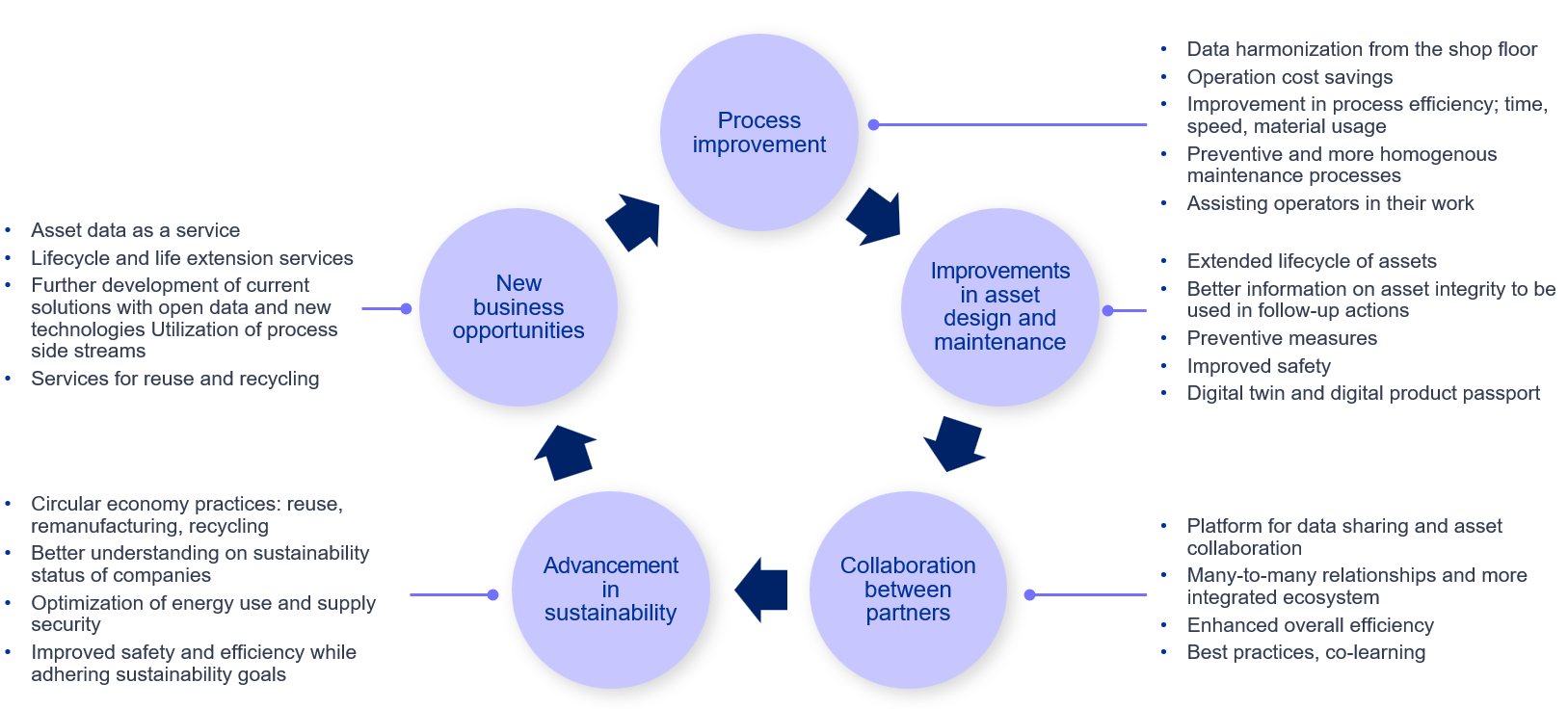
Adapted from Rantala et al. (2025)
Click the image to open a full-screen version and inspect the detailed data flows.
Challenges - identify what currently prevents you from realizing opportunities
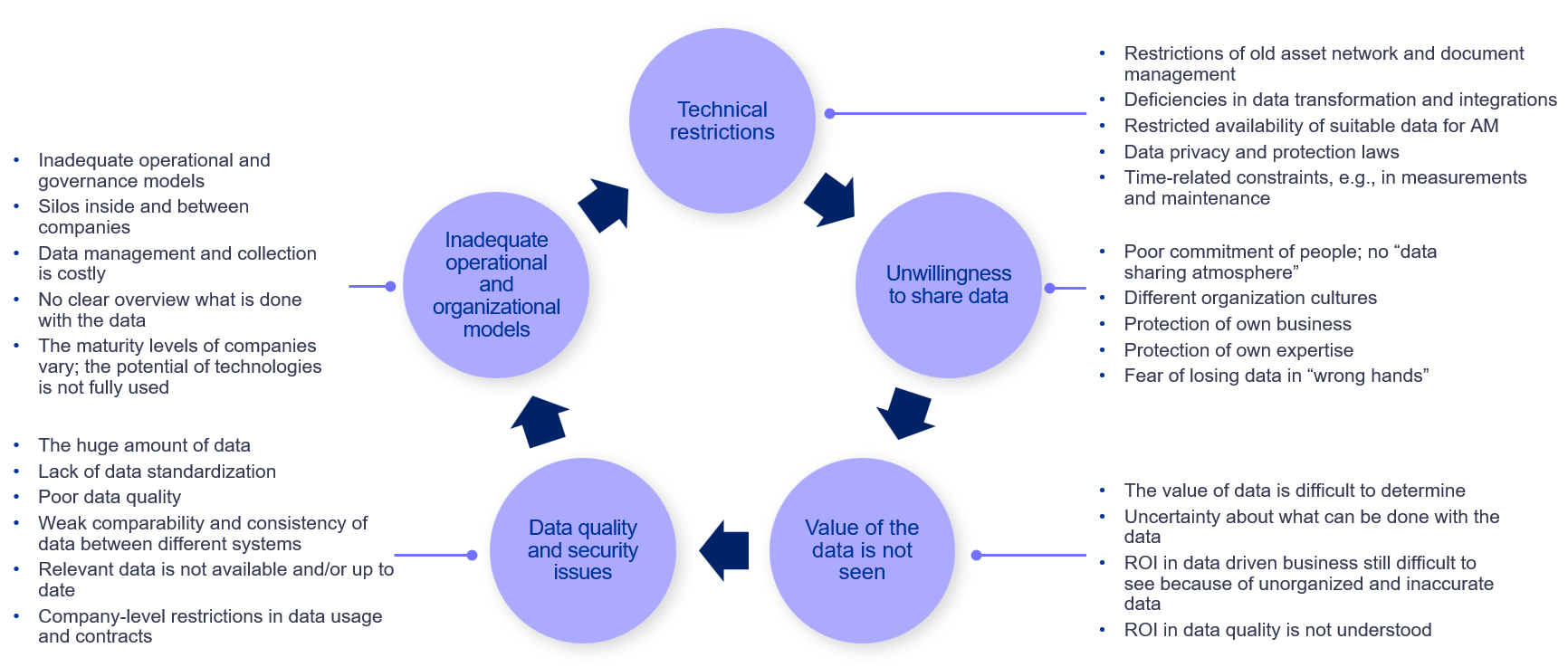
Adapted from Rantala et al. (2025)
Click the image to open a full-screen version and inspect the detailed data flows.
Exploring your starting point - reflecting on Co-AM in your own context
- The questions in the following sections are not meant as a formal assessment, but as a structured way to reflect on your current practices. They help you explore your situation from different viewpoints and consider the relevance of Co-AM in your organization and ecosystem.
- Business: These questions help you reflect on whether shared asset lifecycle data could create concrete business value, new services, or improved performance in your context.
- Governance: These questions help you examine whether data sharing and collaboration can be governed in a fair, trusted, and scalable way across organizational boundaries.
- Data quality and interoperability: These questions help you examine whether your data can actually flow across organizations.
Business - Why would data sharing be worthwhile?
Consider the following questions. If they sparked your thoughts, dive into our more detailed methods.
- Have you identified what kind of lifecycle data of production assets you or your partners own that could create value if it were shared or combined across organizational boundaries?
- Do you face challenges related to production asset performance, availability, lifecycle costs, or sustainability that cannot be solved by a single organization alone?
- Could shared data enable new or improved services, such as lifecycle services, optimization, predictive maintenance, reporting, or compliance?
- Is the value creation logic of shared data clearly defined, or is data being collected without a clear connection to business benefits?
- Do you see genuine win-win opportunities in data sharing for multiple parties, or is data still primarily viewed as a competitive asset that must be protected?
Go to Business opportunities to further examine your business.
Data quality and interoperability - Can data actually flow and be utilized?
Consider the following questions. If they sparked your thoughts, dive into our more detailed methods.
- Is the necessary production asset lifecycle data available in a digital and usable form, covering the required lifecycle phases such as design, operation, maintenance, and end-of-life?
- Is the data quality sufficient for shared use, or is its value limited by incomplete, inconsistent, or outdated data?
- Are data formats, interfaces, and concepts interoperable across organizations, or does interoperability require significant manual effort?
- Is it technically and organizationally defined how data flows between different parties, or does information exchange take place in an ad hoc manner?
- Do you know which data must be kept local and which data can be shared safely with other partners, for example through aggregation, abstraction, or privacy-preserving methods?
Go to Governance - data quality and Governance - interoperability
Continue exploring
- Previous: Review the basics
- Next: Identify your business opportunities